
Faster vulnerability research is lowering the cost of initial access and forcing defenders to rethink traditional threat models
Key Takeaways
- AI is accelerating the discovery of previously unknown software vulnerabilities.
- The greatest immediate impact is occurring at the beginning of the cyber kill chain—reconnaissance, vulnerability research, and initial access.
- Capabilities once limited to well-funded security teams or nation-state actors are becoming accessible to smaller groups with sufficient technical knowledge and an API budget.
- AI Agents can support both source-code auditing and active testing of running applications.
- Post-exploitation activities still require meaningful operator expertise, but faster initial access changes the economics of the entire attack chain.
- Defenders should integrate AI-assisted auditing into existing vulnerability management, static analysis, fuzzing, and penetration-testing workflows.
AI Is Not Replacing the Entire Cyber Kill Chain
Debates about artificial intelligence in cybersecurity often fall into two extremes.
One side argues that AI will fundamentally destroy software security as we know it. The other dismisses AI security capabilities as exaggerated technology that will eventually lose relevance.
The more realistic development lies between those positions.
AI is already demonstrating practical value in vulnerability discovery. Its most significant near-term impact is not the complete automation of sophisticated cyberattacks, but the acceleration of the slow and expensive work that traditionally occurs at the front of the cyber kill chain.
Reconnaissance, source-code review, vulnerability research, hypothesis testing, and exploit validation have historically required substantial time and specialized human effort. When AI compresses that work from weeks into hours, every stage that follows becomes faster and less expensive.
Previously Unknown Vulnerabilities Are Becoming Easier to Find
Recent research cited in the original article illustrates how AI-assisted vulnerability discovery has moved beyond controlled demonstrations.
Google’s Big Sleep Agent reportedly identified an exploitable memory-safety issue in SQLite in late 2024. It later surfaced CVE-2025-6965, a vulnerability associated with possible memory corruption, before attackers could begin a known exploitation campaign.
DARPA’s AI Cyber Challenge also demonstrated how autonomous cyber-reasoning systems could analyze software, identify vulnerabilities, and produce patches. During the competition, participating systems reportedly found most of the synthetic vulnerabilities placed in the challenge environment, generated working patches, and identified previously unknown issues in real-world software.
Independent researchers have achieved similar results using commercially available AI models and relatively modest API spending. In one example discussed in the article, researcher Sean Heelan used OpenAI’s o3 model to identify CVE-2025-37899, a remote vulnerability affecting the Linux kernel’s SMB implementation.
The significance is not simply that AI can find bugs. It is that the cost and time required to conduct meaningful vulnerability research are falling.
Two AI-Assisted Vulnerability Discovery Models
AI-driven vulnerability research can generally be divided into two approaches:
Static auditing
Static auditing examines source code, compiled binaries, or software dependencies without relying on direct interaction with a live target.
An AI-assisted audit can review:
- Input-validation routines
- File-upload functions
- Parsing components
- Authentication logic
- User-controlled data flows
- Calls to sensitive functions
- Trust-boundary violations
- Third-party dependencies
The model can generate hypotheses, identify suspicious code paths, create potential proof-of-concept inputs, and refine its analysis based on test results.
This does not mean the model independently completes every stage of vulnerability research. Human validation remains essential. However, AI can dramatically reduce the amount of repetitive analysis required before a researcher reaches a credible candidate.
Active discovery
Active discovery analyzes a running application without access to its source code.
The Agent sends requests, examines responses, compares timing differences, analyzes error behavior, and determines which probe should be attempted next.
This approach is especially relevant to vulnerabilities that require contextual reasoning rather than simple pattern matching.
Static Analysis Could Produce the Next Public CVE
Apache Struts provides a useful illustration of how AI-assisted source-code analysis could affect future attacks.
Historical Struts vulnerabilities have frequently involved untrusted data crossing a security boundary and being processed under unsafe assumptions. Relevant attack surfaces include:
- Multipart data parsing
- OGNL expression evaluation
- File-upload handling
- Namespace routing
- Request dispatch logic
An AI Agent could examine these components, identify places where attacker-controlled input reaches sensitive operations, and repeatedly test candidate inputs in a sandbox.
A legitimate security researcher could use this capability to identify and responsibly disclose a vulnerability.
An attacker could use the same process to discover a vulnerability privately, validate exploitation against a controlled instance, and develop a working payload before a public CVE or patch exists.
That changes initial access from waiting for vulnerability disclosure to potentially creating the next disclosure.
AI-Discovered Vulnerability Attack Flow
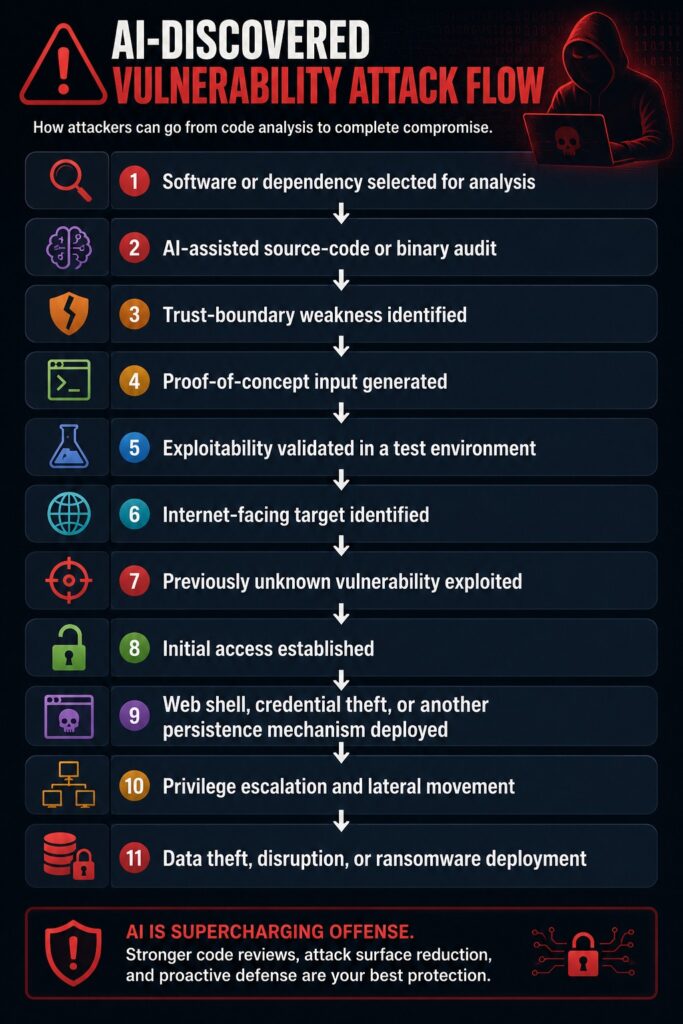
Web Shells Remain a Practical Post-Exploitation Tool
The article presents a scenario in which an attacker discovers a vulnerability in a framework such as Apache Struts and uses it to compromise a financial-services application.
After confirming remote exploitation, the attacker could deploy a memory-resident or file-based web shell to maintain control of the application server.
From that point, the attack would follow a familiar pattern:
- Execute remote commands
- Enumerate accessible systems
- Collect credentials
- Move laterally
- Access backend databases
- Deploy additional malware
- Exfiltrate sensitive information
AI may accelerate the discovery of the vulnerability, but the web shell can still serve as the bridge between initial access and broader compromise.
This reinforces the need to monitor not only known vulnerabilities but also what happens inside the web server after exploitation.
Active Discovery Makes Complex Vulnerabilities More Accessible
Server-side request forgery, or SSRF, demonstrates another area where AI Agents could outperform traditional automated scanners.
Many SSRF vulnerabilities are difficult to confirm because the result is not clearly visible in the application response. Successful detection may require:
- Out-of-band callbacks
- Timing analysis
- Internal address probing
- Redirect-chain analysis
- Protocol-handler testing
- Cloud metadata service interaction
- Input-filter bypasses
- Reasoning about backend behavior
Traditional scanners often rely on predetermined signatures or response patterns. An AI Agent can instead interpret the result of each request and decide what to test next.
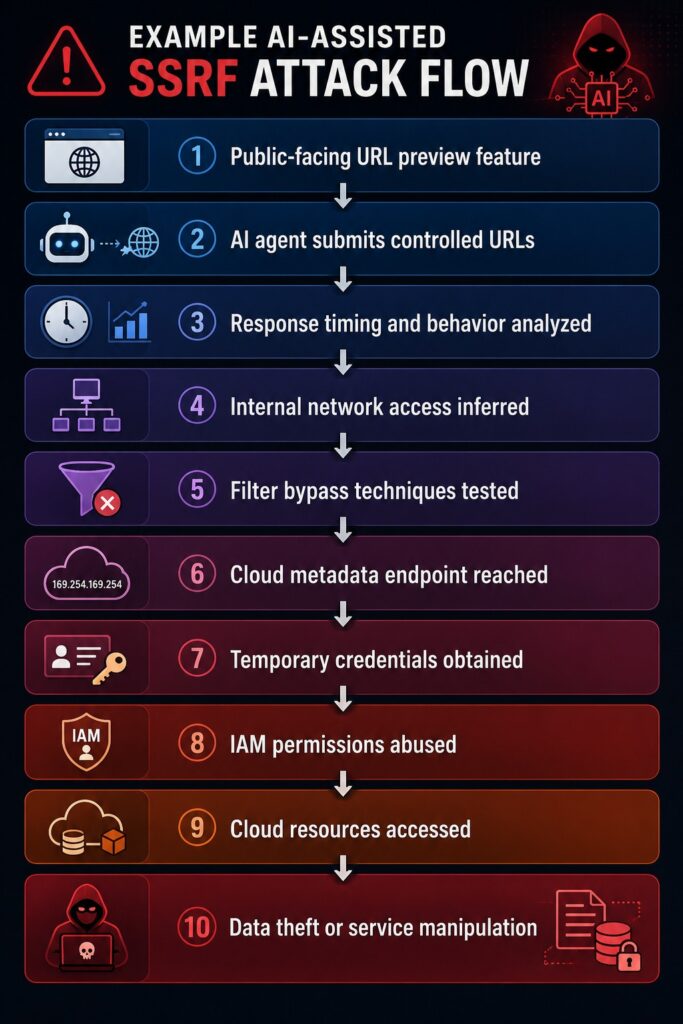
For example, an Agent assessing a URL-preview feature could submit carefully selected hostnames, compare response timing and content length, infer that the server reached an internal resource, and then attempt access to a cloud instance metadata service.
In this scenario, no web shell is necessary. The attack may be complete once temporary cloud credentials are obtained.
Example AI-Assisted SSRF Attack Flow
The Economics of Initial Access Have Changed
Post-exploitation tradecraft has not been fully automated.
Privilege escalation, defense evasion, lateral movement, persistence, and mission execution still benefit greatly from experienced human operators. AI can assist with these activities, but it does not yet eliminate the need for skilled attackers.
The more immediate change is the cost of identifying a viable entry point.
Previously, advanced vulnerability research required specialized teams, significant infrastructure, and lengthy analysis. AI-assisted auditing can make portions of that capability available to smaller threat groups and technically capable individuals.
This means organizations can no longer assume that an obscure open-source library, niche framework, or lightly reviewed dependency will remain unnoticed because it lacks widespread attention.
Low visibility is not a reliable security control.
What This Means for Defenders
The shift toward AI-assisted vulnerability discovery creates several priorities for security teams.
Reassess software dependencies
Organizations should identify outdated, unmaintained, or poorly reviewed components in their software bills of materials.
A library that has attracted little public research may still become an attractive target when an AI system can audit it quickly and cheaply.
Reduce exposure time
The period between vulnerability discovery and exploitation may continue to shrink.
Defenders should improve:
- Asset visibility
- Patch prioritization
- External attack-surface management
- Emergency remediation processes
- Virtual patching
- Compensating controls
Monitor post-exploitation behavior
Organizations cannot assume that every vulnerability will be publicly disclosed before exploitation begins.
Security monitoring should identify indicators such as:
- Unexpected web-server processes
- Suspicious child-process execution
- Unauthorized file creation
- Web shell behavior
- Abnormal outbound connections
- Credential access
- Internal reconnaissance
- Unusual cloud API activity
Use AI defensively
The same technology available to attackers can help defenders analyze code, prioritize findings, generate tests, and recommend patches.
AI-assisted review should complement—not replace—existing tools such as:
- Static application security testing
- Dynamic application security testing
- Software composition analysis
- Fuzzing
- Penetration testing
- Red-team exercises
- Secure code review
WSS AI Insight: Detection Must Continue After Initial Access
AI-assisted vulnerability discovery increases the likelihood that attackers will exploit weaknesses before defenders receive conventional warning through public disclosures or signatures.
In web-server environments, successful exploitation may be followed by the deployment of a new or modified web shell designed to avoid traditional pattern-based detection.
This makes continuous server-side monitoring increasingly important.
WSS AI analyzes suspicious files and web-server activity to help identify known, modified, and previously unseen web shells. Detecting the attacker’s foothold before privilege escalation or lateral movement can reduce the likelihood that a single application vulnerability develops into a broader enterprise compromise.
AI-driven vulnerability discovery changes how quickly attackers may reach the server. AI-assisted behavioral detection can help defenders respond before that access becomes persistent control.
The Next Step for Security Teams
The question is no longer whether AI-assisted vulnerability discovery is technically possible.
Security teams should now determine how to incorporate it into normal operational workflows.
Important questions include:
- Which critical applications should receive AI-assisted code audits?
- Which open-source dependencies have received insufficient review?
- Can discovered weaknesses be validated safely?
- How quickly can the organization generate and deploy patches?
- Are web servers monitored for exploitation that occurs before disclosure?
- Do current threat models account for smaller attackers gaining advanced research capabilities?
Organizations should treat AI-assisted auditing as an additional security capability alongside established testing methods rather than as a replacement for experienced researchers.
Conclusion
AI is reshaping the cyber kill chain, but its most significant immediate effect is occurring at the beginning.
By accelerating reconnaissance, source-code auditing, vulnerability discovery, and exploit validation, AI lowers the cost of obtaining initial access. Attackers who previously depended on public disclosures may increasingly be able to discover exploitable weaknesses themselves.
Defenders have access to the same technology, but gaining value from it will require more than purchasing another security tool. Organizations must integrate AI-assisted analysis into vulnerability management, application security, patching, red-team operations, and post-exploitation monitoring.
The front of the cyber kill chain has already moved. Defensive strategies must move with it.
Related Threat Intelligence
- Web Shells Remain the Primary Entry Point in Windows Web Server Attacks
- Active Exploitation Highlights the Growing Risk of Web Shell-Based Attacks Against Enterprise Applications
- New Linux Vulnerability Possibly Exploited in Attacks
- Suspected North Korean Hackers Linked to Large-Scale Golf Club Data Breach
- GitHub CVE-2026-3854 Enables Remote Code Execution via Single Git Push
- Ivanti EPMM Vulnerability Exploited to Deploy Sleeper Webshells
- Linux Security Alert: Cookie PHP Web Shells (MS Report)
- Dell WMS Vulnerability: Defending Against JSP Webshells
- ASP.NET Web Shell Threats Targeting IIS Servers (UAT-8099 Case Study)
- BeyondTrust Flaw Used for Web Shells, Backdoors, and Data Exfiltration
- Web Shells and Lateral Movement
- Godzilla Webshell: A Growing Cybersecurity Threat to Healthcare
- The Evolution of the China Chopper
- APT41’s Cyber Espionage Campaign: Web Shells at the Core of Network Infiltration