
Major Technology Companies Shift Focus from AI Performance to Cybersecurity Protection
Key Takeaways
- Major AI companies are expanding competition into cybersecurity
- AI systems can now identify software vulnerabilities at scale
- New tools from AWS and Microsoft automate vulnerability validation and remediation
- Security is becoming a key differentiator in the AI market
- Organizations are increasingly adopting AI-assisted cyber defense capabilities
- The trend highlights the growing importance of autonomous security technologies
The AI Competition Is Expanding Beyond Performance
For the past several years, artificial intelligence competition has largely focused on model performance, reasoning capabilities, and benchmark scores.
Today, a new battleground is emerging: cybersecurity.
Major technology companies are introducing AI-powered security solutions designed to identify vulnerabilities, analyze threats, and automate defensive actions. As cyberattacks continue to increase in sophistication, AI is becoming a critical component of modern security operations.
AI Models Are Becoming Security Analysts
One of the most significant developments in recent months is the ability of AI systems to discover software vulnerabilities at scale.
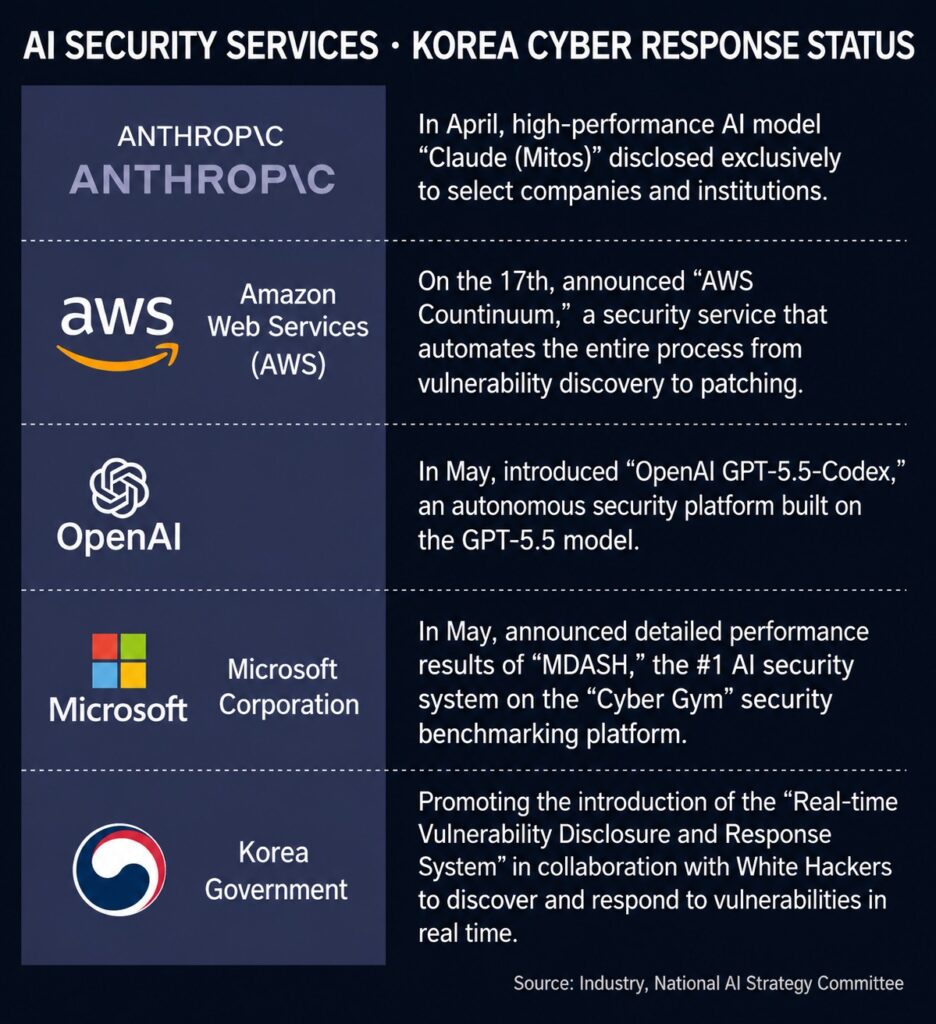
Anthropic’s security-focused AI initiatives demonstrated how advanced models can assist with identifying weaknesses in software environments. This has accelerated industry interest in applying AI to offensive and defensive cybersecurity tasks.
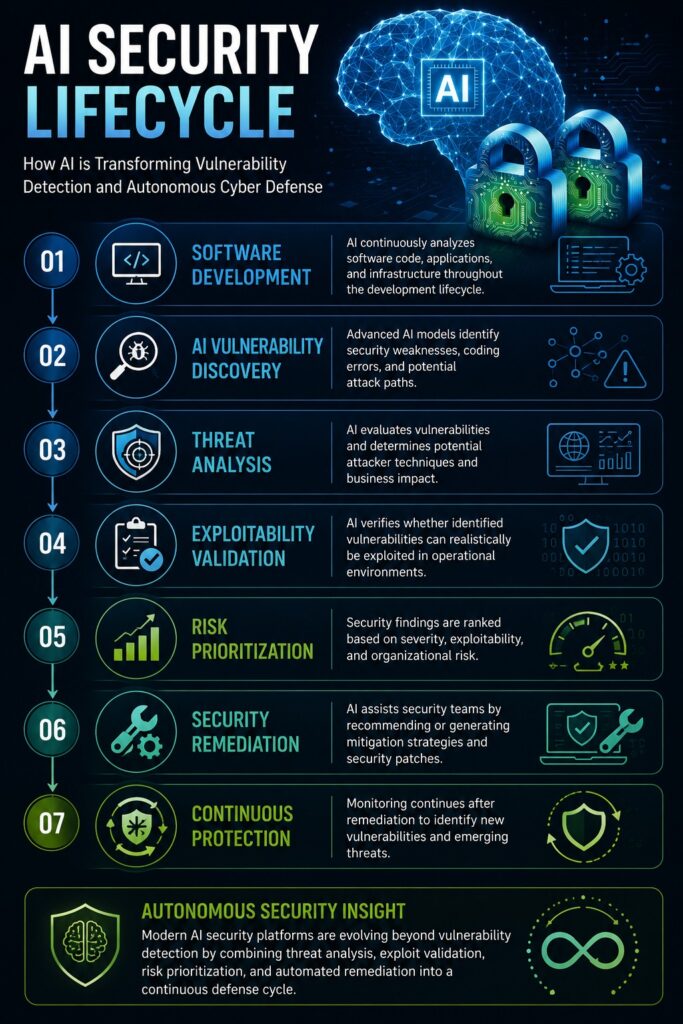
The ability to rapidly analyze code, identify vulnerabilities, and assess exploitability allows organizations to reduce the time required to detect security risks.
AWS Introduces Automated Vulnerability Validation and Patching
Amazon Web Services (AWS) recently introduced a new AI-powered security capability designed to help organizations identify and remediate software vulnerabilities.
Unlike traditional vulnerability scanners that simply report findings, the system can evaluate exploitability and assist in generating remediation recommendations.
This approach helps security teams prioritize vulnerabilities that present actual business risk rather than focusing solely on theoretical exposure.
Microsoft Expands Multi-Agent Security Research
Microsoft has also introduced new security-focused AI technologies designed to improve vulnerability analysis and threat detection.
One example is MDASH (Multi-Model Agentic Scanning Harness), which leverages multiple specialized AI agents to evaluate vulnerabilities and security weaknesses.
The use of multiple AI agents allows organizations to perform broader and more scalable security assessments across large environments.
AI Security Lifecycle
AI Security Services
Why Autonomous Security Matters
Traditional security operations often struggle to keep pace with the volume of software vulnerabilities discovered each year.
AI-driven security platforms can assist by:
- Identifying vulnerabilities faster
- Reducing manual analysis effort
- Prioritizing high-risk findings
- Accelerating remediation
- Improving security visibility
- Supporting continuous monitoring
These capabilities can help organizations reduce exposure windows and strengthen cyber resilience.
Security Implications for Organizations
The rapid development of AI-powered security tools demonstrates that cybersecurity is becoming one of the most important application areas for artificial intelligence.
Organizations should expect increased adoption of:
- AI-assisted vulnerability management
- Automated threat analysis
- Autonomous remediation workflows
- AI-powered security operations
- Real-time risk assessment systems
As threats continue to evolve, security teams will increasingly rely on AI to improve response speed and operational efficiency.
The Future of AI Security
The next phase of AI innovation may not be defined solely by larger language models or benchmark performance.
Instead, it may be measured by how effectively AI can identify vulnerabilities, defend critical infrastructure, and reduce cyber risk.
The shift toward autonomous security technologies signals a new chapter in the evolution of cybersecurity.
Related Threat Intelligence
- New Linux Vulnerability Possibly Exploited in Attacks
- Suspected North Korean Hackers Linked to Large-Scale Golf Club Data Breach
- GitHub CVE-2026-3854 Enables Remote Code Execution via Single Git Push
- Ivanti EPMM Vulnerability Exploited to Deploy Sleeper Webshells
- Linux Security Alert: Cookie PHP Web Shells (MS Report)
- Dell WMS Vulnerability: Defending Against JSP Webshells
- ASP.NET Web Shell Threats Targeting IIS Servers (UAT-8099 Case Study)
- BeyondTrust Flaw Used for Web Shells, Backdoors, and Data Exfiltration
- Web Shells and Lateral Movement
- Godzilla Webshell: A Growing Cybersecurity Threat to Healthcare
- The Evolution of the China Chopper
- APT41’s Cyber Espionage Campaign: Web Shells at the Core of Network Infiltration
Sources
News: AI Security Race Accelerates: From Vulnerability Detection to Autonomous Defense