
New Linux Kernel Flaw Enables Attackers to Escalate from Local User to Root Privileges
Key Takeaways
- Dirty Frag enables local privilege escalation to root on vulnerable Linux systems
- Tracked as CVE-2026-43284 and CVE-2026-43500
- Public proof-of-concept exploit has been released
- Researchers warn the vulnerability may already be used in limited attacks
- Affected systems include major Linux distributions and enterprise environments
- Root-level access can lead to malware deployment, persistence, and full system compromise
Linux Systems Face New Privilege Escalation Threat
Security researchers have disclosed a critical Linux privilege escalation vulnerability chain known as Dirty Frag, tracked as CVE-2026-43284 and CVE-2026-43500.
The vulnerability affects Linux kernel networking and memory-fragment handling components and enables attackers with local access to escalate privileges to root. Public reporting indicates that exploitation may already be occurring in limited attacks, raising concerns for organizations operating Linux servers and cloud workloads.
Unlike many traditional Linux privilege escalation vulnerabilities that depend on race conditions and unstable execution paths, Dirty Frag is designed to provide more reliable and repeatable exploitation.
What Is Dirty Frag?
Dirty Frag is a Linux kernel vulnerability chain that abuses flaws within the ESP (IPsec) and RxRPC subsystems.
Researchers found that attackers can manipulate page-cache-backed memory and kernel networking behavior to gain root privileges without modifying files directly on disk. The vulnerability affects systems running vulnerable Linux kernel versions and can potentially impact major Linux distributions used in enterprise environments.
Because root access provides complete control of the operating system, successful exploitation can significantly increase post-compromise risk.
Why Dirty Frag Is Different From Previous Linux LPE Vulnerabilities
Many Linux Local Privilege Escalation (LPE) vulnerabilities rely on unstable timing conditions that make exploitation inconsistent.
Dirty Frag introduces multiple attack paths through vulnerable kernel components, increasing reliability and making exploitation more predictable across different environments. Researchers note that the technique expands privilege escalation opportunities compared to previous vulnerabilities such as Copy Fail and Dirty Pipe.
This reliability makes the vulnerability particularly concerning for organizations that depend on Linux-based infrastructure.
Potential Security Impact
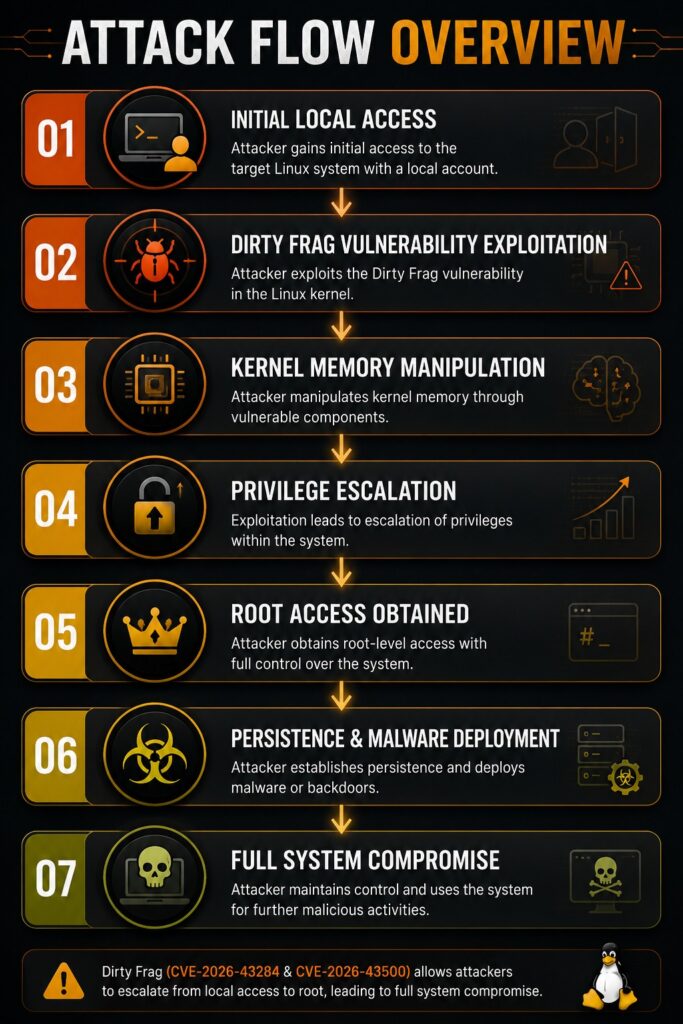
Once root privileges are obtained, attackers may:
- Install malware or backdoors
- Establish long-term persistence
- Disable security controls
- Access sensitive business data
- Move laterally across infrastructure
- Deploy ransomware or additional payloads
Because Linux systems often host critical applications, databases, web services, and cloud workloads, successful privilege escalation can have significant operational impact.
Attack Flow Overview
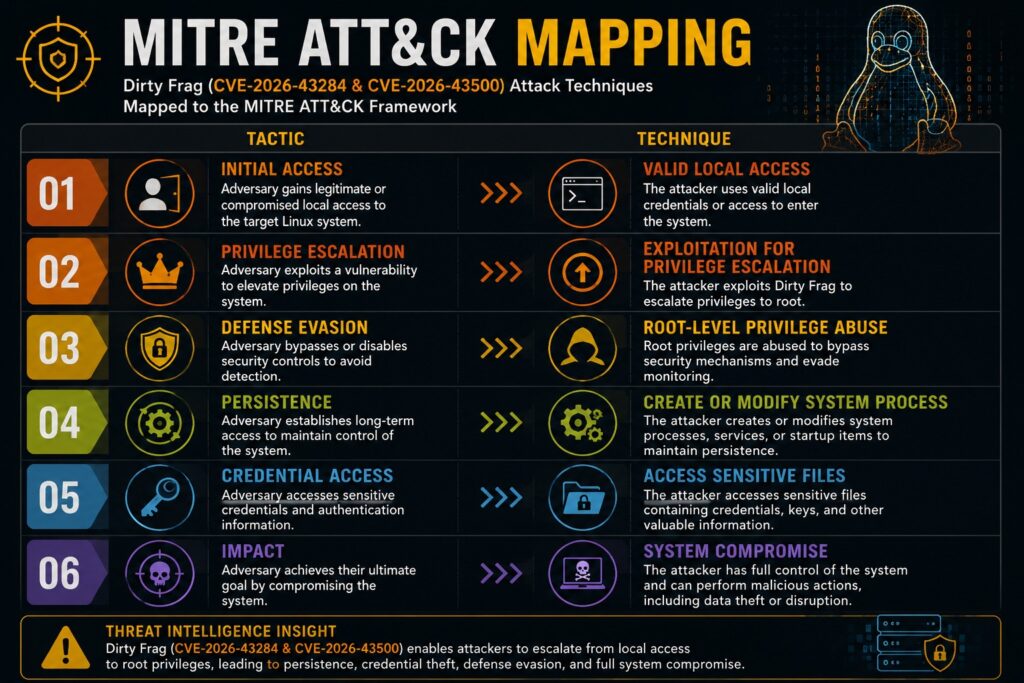
MITRE ATT&CK Mapping
WSS Detection Points
While Dirty Frag itself targets Linux kernel components, successful exploitation often leads to post-compromise activity that can be monitored.
Organizations should watch for:
- Suspicious privilege escalation behavior
- Unexpected root-level processes
- Unauthorized file modifications
- Persistence-related activity
- Abnormal server-side execution patterns
- Web service anomalies following compromise
Advanced monitoring and detection solutions can help identify suspicious activity occurring after successful exploitation attempts.
Mitigation Recommendations
Organizations should:
- Apply vendor security updates as soon as patches become available
- Monitor Linux servers for abnormal privilege escalation activity
- Restrict unnecessary local access
- Review system logs for indicators of compromise
- Validate kernel versions across infrastructure
- Implement continuous threat monitoring
Where patching is not immediately possible, temporary mitigations may help reduce exposure until official fixes are deployed.
Growing Risks in Linux Infrastructure Security
Dirty Frag highlights how Linux kernel vulnerabilities continue to evolve beyond traditional race-condition-based attacks.
As attackers seek more reliable privilege escalation methods, organizations operating Linux servers, cloud workloads, and critical infrastructure must strengthen visibility into post-compromise behavior and privilege escalation activity.
The combination of public exploit availability and potential in-the-wild activity makes Dirty Frag a vulnerability that security teams should monitor closely.
Related Threat Intelligence
- Suspected North Korean Hackers Linked to Large-Scale Golf Club Data Breach
- GitHub CVE-2026-3854 Enables Remote Code Execution via Single Git Push
- Ivanti EPMM Vulnerability Exploited to Deploy Sleeper Webshells
- Linux Security Alert: Cookie PHP Web Shells (MS Report)
- Dell WMS Vulnerability: Defending Against JSP Webshells
- ASP.NET Web Shell Threats Targeting IIS Servers (UAT-8099 Case Study)
- BeyondTrust Flaw Used for Web Shells, Backdoors, and Data Exfiltration
- Web Shells and Lateral Movement
- Godzilla Webshell: A Growing Cybersecurity Threat to Healthcare
- The Evolution of the China Chopper
- APT41’s Cyber Espionage Campaign: Web Shells at the Core of Network Infiltration
Sources
News: New ‘Dirty Frag’ Linux Vulnerability Possibly Exploited in Attacks